


Redcast x Momotaro "Wabi-Sabi" Kakishibu Jeans Collaboration
This project began more than two years ago, during a visit to Madrid by Keita Hinamoto. At the time, Momotaro had never produced a Kakishibu denim, and we proposed the idea of developing something entirely new together. Several Japanese brands had already explored combinations of indigo warp and Kakishibu weft—but always in unsanforized fabrics, often with heavy texture and pronounced slub.
We wanted something different.
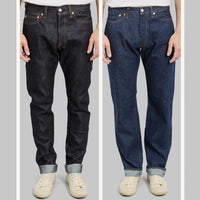
This LIMITED EDITION comprises 200 pairs of selvedge Jeans in Momotaro's #100 Straight cut.
We're proud to present the limited "Wabi-Sabi" KAKISHIBU Jeans—set to launch on February 13th.

Our vision was clear from the start: a fabric that felt elegant, minimal, and intentional. No exaggerated texture. No visual noise. A denim where all the character lived in the color, the cut, and the details, rather than in surface irregularities. A fabric that felt structured and smooth, yet deeply expressive..
The result is one of the most special denims we’ve ever worked with.
Developing the Fabric
Momotaro is one of the very few Japanese brands that owns and operates its own looms, which gave us the freedom to experiment extensively. Over the course of roughly eight months, Keita worked closely with the mill team, testing multiple weights, tensions, and—most critically—different Kakishibu tones for the weft yarn.
Kakishibu, made from unripe persimmon fruit, is not a dye you can rush. The fruits are harvested in autumn and early winter—often appearing as vivid orange dots against snowy landscapes—then crushed, fermented, and reduced into a tannin-rich liquid. The process has existed in Japan since at least the 13th century and has historically been used for textiles, fishing nets, wood finishing, and even sake production.
For this project, we carefully selected the number of dye layers applied to the Kakishibu weft, balancing depth and clarity. Like henna, Kakishibu is an oxidation tannin: its color deepens with exposure to air and sunlight, meaning the denim will continue to evolve over time.

The final fabric is a 15.7oz sanforized denim, woven at high tension. The warp uses pure rope-dyed indigo, while the weft is dyed in natural Kakishibu, both spun from Zimbabwe cotton, prized for its long staple length, strength, and soft yet resilient handfeel.
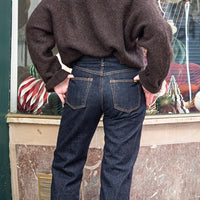
The surface is rigid and smooth, with virtually no slub. The color, however, is extraordinary: a deep indigo face subtly warmed by the persimmon-dyed weft beneath, producing a muted, earthy tone that feels calm, refined, and quietly powerful.
Wabi-Sabi and the meaning of Kakishibu
Kaki (柿) means persimmon. Shibu (渋) means astringent. Together, Kakishibu represents more than a dye—it embodies a philosophy.
The persimmon has long symbolized longevity and good fortune in Japan, and Kakishibu itself aligns closely with the concept of Wabi-Sabi: finding beauty in imperfection, impermanence, and natural aging. On textiles, Kakishibu is non-toxic and imparts water resistance, antiseptic qualities, insect repellence, and mildew resistance.
No two dye baths are identical. No two garments age the same. That variability is not a flaw—it is the point.
When Fabric leads the Design
Once the fabric was finalized, the project entered its most demanding phase: translating its character into construction details.
Because the denim is so smooth and visually restrained, every choice mattered. There was nowhere to hide.
The hardware became the first major challenge. Momotaro’s current post-rebranding buttons and rivets are excellent, but visually they were either too bright or too dark for the Kakishibu tone. The solution came unexpectedly.
One day, while wearing an old pair of Momotaro Legacy Blue jeans, we noticed how their original hardware—a matte copper with a warm brown undertone—responded to light. When placed next to the Kakishibu fabric sample, it was immediately clear: this was the missing piece.
There was just one problem—Momotaro hadn’t produced that hardware in years.
Reviving it exclusively for a run of just 200 pairs required effort, commitment, and belief in the project. Thanks to Sota Furutsuka’s involvement and shared vision, the Legacy Blue buttons and rivets were brought back specifically for this collaboration.

The stitching followed the same philosophy. Although the warp is indigo, the Kakishibu weft constantly influences the overall tone. Multiple thread colors were tested until we found one that felt fully integrated—neither too blue nor too brown, but balanced between both.
The leather patch was designed with restraint and poetry in mind. This time, we turned to a Japanese perspective for the artwork, centering the persimmon as the core symbol. The patch is made from 0.2 mm natural cowhide, stitched tonally and left undyed so it will darken naturally over time, gradually becoming more caramel and more in harmony with the fabric.
Inside the jeans, details continue quietly. The pocket bags use Momotaro’s heavy-duty canvas, customized with a silkscreened collaboration illustration on the left pocket. Each pair is individually numbered from 1 to 200.

The waistband yoke lining features a Japanese indigo kasuri fabric, chosen for its depth and handmade character. The pocket flasher is made from a silky kaki-colored fabric, directly referencing the Kakishibu narrative.
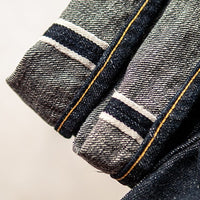
Even the selvedge ID was intentional: peach–brown–peach. Peach is Momotaro’s historic selvedge signature, while the brown center thread represents the Kakishibu weft.
Nothing here is decorative for decoration’s sake. Every decision exists to support the fabric.
The Fit: #100 Straight
For the silhouette, we chose Momotaro’s #100 Straight, developed during the brand’s rebranding and, in our opinion, their most balanced straight cut to date.
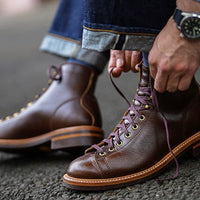
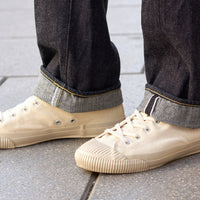
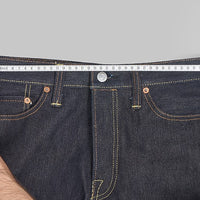
It features a high rise, comfortable room through the thighs, and an almost nonexistent taper from the knee down. It works effortlessly with heritage boots and denim jackets, but looks equally strong with white sneakers and more modern outfits.

Our recommendation: wear them with a single or double Japanese cuff—the Kakishibu weft reveals itself beautifully when paired with the right footwear.
Limited to 200 Pairs
Producing such a fabric in a run of only 200 pairs is never easy. Mills typically require far larger quantities. But Momotaro believed in the project as much as we did and agreed to produce the denim exclusively for this collaboration.
Each pair is individually numbered, and once they’re gone, they will never be reproduced.
A Collaboration Worth the Time
This collaboration took more than two years from idea to completion. It required patience, trust, and an obsession with detail at every stage.
The Redcast Heritage x Momotaro "Wabi-Sabi" Kakishibu 15.7oz #100 Jeans are not about trends or spectacle. They are about balance, material honesty, and quiet confidence.
One fabric. One cut. 200 pairs.
And every one of them tells the same story—slightly differently.

The Redcast x Momotaro "Wabi-Sabi" KAKISHIBU 15.7oz Limited Edition will only be for sale on our website and will be available from Friday 13 February 2026 until stock lasts (limited to 200 Jeans). We numbered each one of the units in this limited series.

The countdown has started!


COMMENTS ON THIS POST (4)
Connor Olson
Really, really cool run. I would love to own a pair of these beautiful jeans. However, I am a bit confused as to why they are called Wabi-Sabi (finding beauty in imperfections), when as stated, the entire purpose of this run was to do a Kakishibu weft denim with minimal to zero surface irregularities, slub, and visual noise. Based on my understanding of the concept, this seems contradictory to Wabi-Sabi, which would embrace irregularities and imperfections. Regardless, these look amazing and are a project Redcast and Momotaro should be very proud of.
Brendon Gumpert
I own a pair of Momotaro from before they started Sanforizing their fabric. Sanforized denim has no character or texture and is why contemporary jeans are so boring. It’s so disappointing to see them completely abandon raw denim and it’s a real shame Redcast couldn’t get these jeans made with the texture and nuance that made Momotaro a name worth the money.
Daniel Torres
I can’t wait I’m so excited for this drop I hope I get a pair
The Moor
These Redcast x Momotaro Wabi-Sabi Kakishibu sanforized jeans would look good with my pair of Truman Coach Rambler heritage boots. I trust I am blessed to purchase 1 pair of 200!
Leave a comment
This site is protected by hCaptcha and the hCaptcha Privacy Policy and Terms of Service apply.